google.com, pub-8985115814551729, DIRECT, f08c47fec0942fa0 Free Printable Lesson Plans: recipes
Showing posts with label recipes. Show all posts

Free printable Stone Soup lesson plans, recipes and sharing activities


Hello my Omschooligans! Today Teacher Omi (Grandma, that's me!) is thinking about gardens. I got a pretty herb garden for Mother's Day. And my Louisiana grandkids have a huge garden full of good things to eat! So I am going share some gardening and cooking activities from one of my favorite books, called Stone Soup." The legend of "Stone Soup" is a timeless classic. It's been retold many times, notably by Marcia Brown, Ann McGovern and Jon J. Muth. This story is sacred text in preschool and elementary classrooms. Here are free printable Stone Soup lesson plans just in time for summer produce harvest! First, let's start with the recipe and a game to play!


🍲 The Magic of Stone Soup

A Recipe for Sharing and Community

Prep time: 15 mins | Cook time: 45 mins | Serves: A whole village


Ingredients

  • 1 Large, Smooth Stone (Scrubbed very clean!)

  • 6 cups Water or vegetable broth

  • 3 large Carrots, sliced into rounds

  • 3 stalks Celery, chopped

  • 1 large Onion, diced

  • 4 medium Potatoes, cubed

  • 1 cup Green beans or peas or corn

  • 2 cups chopped cabbage

  • 1 can (15 oz) Diced tomatoes

  • 2 cloves Garlic, minced

  • Fresh Herbs: Parsley, thyme, or bay leaf

  • Salt & Pepper to taste

  • Optional: A handful of barley or small pasta, some cubed beef roast and a little milk or cream. If you can coax it out of your little villagers 😆

Instructions

  1. The Secret Start: Place your "magic" stone in the bottom of a large heavy pot. I would use a crock pot or slow cooker for safety in the classroom. Fill the pot with water or broth and bring it to a gentle boil.

  2. The First Contribution: Add the onions and garlic. Let them simmer until the water begins to smell fragrant.

  3. Building the Flavor: Add the potatoes, carrots, and celery. As the legend goes, "a bit of this and a bit of that" makes the soup better.

  4. The Final Additions: Stir in the tomatoes, green beans, and herbs. Reduce the heat to low, cover, and simmer for about 30–40 minutes until all the vegetables are tender.

  5. The Seasoning: Remove the lid and add salt and pepper. If you have a crusty loaf of bread nearby, now is the time to slice it!

  6. The Reveal: Carefully remove the stone (save it for next time!) and serve the soup hot to friends, family, and neighbors.

"It is amazing how much flavor a simple stone can have... when everyone adds a little something to the pot."

🎨 Teacher Omi’s "Sharing Soup" Game

The Setup: Ask each child to bring in one small vegetable or ingredient (or provide them yourself) and have the children "hide" them—either in their desks, under their chairs, or behind their backs during circle time. 

The "Wondering": Place your pot and "magic stone" in the center of the circle. Begin to "wonder" aloud.

  • "Oh, this stone soup smells lovely, but it would be so much better if only we had a bright, crunchy carrot..."

The Magic: The child with the carrot then "finds" it and brings it forward to the pot to share! Continue until every child has contributed their piece to the village feast.

            The Lesson: It transforms a simple recipe into a lesson on how everyone has something valuable to contribute, no matter how small.

Souper Simple Sharing Soup


So you could make a "Souper Simple Sharing Soup" for Thanksgiving or any time, just by asking each child to bring in one can of his favorite vegetables. This "souper simple" recipe works well in classrooms because it's quick and easy to make. All you need is a can opener and a crockpot, if a stove isn't available. It's endlessly creative and never turns out the same! It was fun to see how many different kinds of vegetables were brought in. It's also cheap and easy for parents. You could do it with frozen or fresh vegetables too. 

And now for the free Stone Soup printables

Literature Connections

Marcia Brown's "Stone Soup" is the oldest book version (1947). It was a Caldecott honor book. Brown also wrote other Caldecott children's literature winners "Shadow" and "Once a Mouse." Ann McGovern is the "If you lived..." book lady. In the 1960s she wrote a non-fiction Scholastic series on what it would be like to live with Sioux Indians, Colonial Times, etc. 

Books in the Series by Ann McGovern

  • If You Lived in Colonial Times (1964) – Covers life in the New England colonies between 1650 and 1750.

  • If You Grew Up With Abraham Lincoln (1966) – Details what it was like to live on the frontier and in the city during Lincoln's time.

  • If You Sailed on the Mayflower in 1620 (1969) – Explores the journey and the first year of the Pilgrims in Plymouth.

  • If You Lived in the Circus (1971) – A look behind the scenes of traveling circus life.

  • If You Lived With the Sioux Indians (1972) – Describes the daily life, traditions, and hunting practices of the Sioux on the Great Plains. (We know now it's not accurate to call them Sioux. They are correctly called Lakota. And we now say American Indians or native American or indigenous. But it's still a good book.)  

  • If You Lived 100 Years Ago (1999) – Focuses on life at the turn of the 20th century (specifically in New York City).

  • If You Lived in the Days of the Knights (2001) – Covers the training, armor, and daily routines of medieval knights in the 13th century.


    Jon J. Muth wrote a Japanese version of Stone Soup. Muth is a celebrated author and illustrator whose career spans award-winning children's picture books and influential graphic novels. He is perhaps best known for his series featuring Stillwater the giant panda. Many of these works are inspired by Zen koans and Buddhist parables.

    TitleYearNotable Awards/Honors
    Stillwater and Koo Save the World2023
    Addy's Cup of Sugar2020
    Zen Happiness2019
    Mama Lion Wins the Race2017
    Zen Socks2015Junior Library Guild Selection
    Hi, Koo!: A Year of Seasons2014Beehive Book Award (Poetry)
    Zen Ghosts2010
    Zen Ties2008Children's Choice Book Award (Illustrator of the Year)
    Zen Shorts2005Caldecott Honor; Book Sense Book of the Year
    Stone Soup2003
    The Three Questions2002National Children's Publication Award

Teacher Omi’s Note on Evolving Language

When we read books written several decades ago, like those by Ann McGovern, we sometimes find words that were commonly used then but have since been corrected.

  • The term "Sioux" is actually an exonym—a name given to a group by outsiders. It originated from a French version of an Ojibwe word that meant "little snakes" or "enemies." 

    • The Preferred Name: Most people within that nation prefer Lakota, Dakota, or Nakota (depending on their specific dialect and region).

    • The Meaning: In their own language, these names mean "allies" or "friends." It’s a much more beautiful and accurate way to describe their community!

    • Oceti Sakowin: You may also see the term Oceti Sakowin (The Seven Council Fires), which is the proper collective name for the entire alliance of these bands.


Geography Landforms craft projects and free printable topography maps and lesson plans


Hello my Omschooligans! Today in the Omschool you and I are going to make some hands-on Geography crafts projects. We'll begin by making topography maps. Let's first mix up a large batch of play dough. Make the play dough in class and use it for interactive math measuring lesson plans. Here's an easy play dough recipe.  Students will use these in hands-on geography lessons.


🥣 Omschool Kitchen Science: Topography Play Dough

Turn your kitchen into a geography lab with this simple, non-toxic recipe. Use this for interactive lessons in fractions and measurement before the geography lesson begins!

Yield: 1 Student Portion (Multiply for class size)

Ingredients:

  • 1 cup Hot water

  • 1 cup White flour

  • 1/4 cup Salt

  • 1 tsp Vegetable oil

  • 2 tsp Alum (or Cream of Tartar)

  • Food Coloring (Blue and Green/Plain)

Instructions:

  1. Mix: Combine ingredients with a fork until the dough is smooth and cool enough to handle.

  2. Divide: Separate the dough into two equal balls.

  3. Color: Leave one ball plain (Land) and color the other blue (Water).

  4. Prep: Give each student a paper plate, a plastic knife, and two zippered bags for storage.


Next, introduce geography bee terms and definitions for landforms. Demonstrate shapes of landforms using play dough and then by drawing landforms on the overhead projector. Use black pen for land and blue for water. Students will use their blue and white clay to create landforms based on drawings from the board or overhead projector. Students should locate examples of landforms on topography maps or globes with 3D landforms. 

👩‍🏫 Omi’s Pro-Tip for the Classroom:

"When modeling these landforms for the class, I like to use a black pen for land and blue for water on the overhead projector. This way, the students can perfectly match their clay colors to my drawings on the board. It keeps everyone on the same page (and the same continent!)"

🗺️ Geography Bee: Landform Key

Use these definitions and examples to identify features on your topography maps and globes.

Water-to-Land Connections

  • Isthmus: A narrow strip of land separating two large bodies of water and connecting two larger landmasses (e.g., Isthmus of Panama).

  • Strait: A narrow strip of water separating two large landmasses and connecting two larger bodies of water—the inverse of an isthmus (e.g., Straits of Mackinac).

  • Delta: The mouth of a river where it fans out in silt or tributaries to meet a larger body of water (e.g., Mississippi Delta).

Island & Coastal Features

  • Island: A small landmass surrounded by water.

  • Archipelago: A chain or group of islands (e.g., Hawaii).

  • Atoll: A circular ring of islands, often surrounding a lagoon.

  • Peninsula: Land that juts out into a body of water (e.g., Michigan, Florida).

  • Key: A small island in a chain.

Inland Water Features

  • River: A narrow strip of water flowing from high to low elevation.

  • Tributary: A branch or smaller stream that flows into a main river.

  • Lake: A large body of water, generally smaller than a sea (e.g., Lake Superior).

  • Basin: The area along a river that is drained by that river.

Elevation & Terrain (Highlands)

  • Mountain: A high area of land rising to a peak.

  • Mesa: A steep, narrow elevation with a flat top—like a table.

  • Butte: An isolated rocky hill with vertical sides and a flat surface.

  • Plateau: A wide, expansive area of high, flat land.

  • Cliff/Bluff: Sharp or rounded edges where land drops off to a lower elevation.

Terrain (Lowlands & Passages)

  • Canyon: A narrow corridor or pass between rocky elevations.

  • Gorge: A canyon with a riverbed at the bottom (e.g., Snake River Canyon).

  • Dune: A sandy elevation, often found along the shoreline.

Printable landforms charts


🌍 Landform Discovery Chart

CategoryLandform TypeDescription
HighlandsMountain, Mesa, Butte, Plateau, Hill, Bluff, Cliff, PromontoryElevated areas ranging from sharp peaks to flat-topped "tables."
LowlandsValley, Canyon, Dune, BasinAreas that sit below the surrounding terrain, often carved by water or wind.
Water FeaturesRiver, Tributary, Lake, Bay, Sea, OceanBodies of water that vary by size, salt content, and movement.
Coastal & IslandsPeninsula, Cape, Delta, Strait, Isthmus, Archipelago, Atoll, KeyLand features defined by their relationship and proximity to the sea.

📚 Montessori-Style Landform 3-Part Cards

  • The Helpful Garden: Offers a fantastic free download of land and water forms using real-life photographs. These are highly recommended by Montessori educators for their clarity.

  • Kid World Citizen: Provides 20 free landform posters with beautiful illustrations and definitions that can be used for a matching game or a classroom word wall.

  • Landforms Match-Up Foldable: A free TPT resource that includes photos and definitions for 8 key landforms (plateau, isthmus, cape, etc.) specifically designed to be used in a graphic organizer.

🧩 Landform Matching Worksheets & Games

  • Super Teacher Worksheets: A great set of 2nd-4th grade picture cards that can be used for a memory game or a classic "question and answer" review.

  • Tutoring Hour Landform Pack: This site has a massive collection of free PDFs, including a "Cut and Glue" matching activity where students match picture cards to written descriptions.

  • Landforms on Earth Flashcards: A set of 12 vibrant, colorful flashcards perfect for visual learners to identify key terrain features.

Assorted Links for Geography worksheets to print. 


A-Z Healthy School Lunches and kid-friendly lunchbox food recipes for back-to-school nutrition


Looking for free nutrition lesson plans? Look no further than your kid's lunchbox. Helping students plan and prepare healthy school lunches is one of the best learning activities you can do. Check out my month-long menu of easy, quick A-Z school lunch recipes. Kids'll eat up these healthy school lunches and lunchbox recipes and beg you for more! Here are some free printable nutrition lesson plans and resources from MyPlate for lesson extenders. 

First, teach students about food safety by showing them how to keep food fresh with a freezer ice pack or bento box with freezable tray. Make it part of their chores to wash daily, freeze overnight and pop in lunch box in the morning. Next, make the preparation school lunches part of the lesson plans. 

Teach kids to always read product nutrition data. Some foods are surprisingly high in sugar, salt, junk fat and additives. Help them to compare which brands are healthier than others. Have them use snack-sized zippered bags for kid-friendly portion control and to avoid waste. Rotate this A-Z school lunch menu monthly so kids won't get bored.

 A-Z lunch menu of quick lunch recipes and lunchbox foods for kids

 A+ Applewich: Spread light oat grain bread with almond butter or natural peanut butter (no transfat). Add sliced apples or apple butter. This will be in hot demand on your monthly lunch menu.

 Banana Boats--cut two slits in banana and peel back skin part way. Remove a little banana and fill with peanut butter and apple slices. Save removed banana for PBB sandwiches (lunch recipes below)

Cheez-its crackers with dried apples or apple slices--sprinkle apples with lemon juice and store these  lunchbox foods separately.

Dogs in the blanket--Smart dogs (made with tofu) or nitrate-free beef hotdogs with honey mustard or hummus and wrapped in lettuce leaves

Eggs Devilishly Good--Hard boil eggs, chill and peel. Rinse and slice lengthwise. Remove yolk and  mash with light olive oil mayo, spicy or horseradish mustard, dill weed and paprika. Fill egg cavities. 

Fruit Max--Mix dried apricots, raisins, apples, guava papaya (don't get sugared ones) with nuts, seeds  and pretzels

GORP (good old raisins and peanuts) or almonds, walnuts or any nuts or seeds. Personal favorite: pepitas or pumpkin seeds

Happy Trails Mix-- Mix unsweetened breakfast cereal, pretzels, raisins, cheese cubes and dark chocolate chips (just a few) for yummy lunchbox foods.

Insanely Healthy Peanut Butter Dip (peanut butter and plain Greek yogurt mixed half and half) with  rice crackers, strawberries, pineapple, baby carrots, green pepper spears.

Jumble nut butter oatmeal cookies--Make with healthy sunflower oil and blue agave syrup to sweeten. Use different nut butters (peanut, cashew, almond or sunflower). Add mixed nuts and seeds  for remarkably filling protein alternatives for vegetarian lunch recipes.

Kangaroo Sandwiches--Stuff pita pocket bread with lettuce and chicken or tuna salad. Mix tuna or  chicken with light mayo, spicy mustard, chopped celery, apples, grapes, nuts and black pepper. Be  sure to call it Kangaroo Sandwiches on the lunch menu!

Lighten Up Roll-ups--spread tortilla shell with light cream cheese or hummus, turkey lunchmeat, large romaine lettuce leaf. Roll and slice. For gluten-free roll up, roll cheese stick in lunch meat or cheese slices

Mucho Guacamole Boats--remove pits from avocado and scrape out some avocado. Mix with lemon juice, garlic, tomatoes, onions for guacamole. Tuck tortilla chips inside avocado, fill cavity with  guacamole and sprinkle with cheese. Send some chips separately. How's that for super healthy  school lunches in minutes?

Nuts and bolts--pretzels, dried fruit and Honey Nut Cheerios. Send almond milk or lowfat milk for  lunch cereal.

Olives overboard pasta salad--Cook whole grain pasta, drain and chill. Add cubed feta cheese,  cucumber chunks, green and black olives and a little olive oil for vegetarian lunch recipes.

Po'boy Shish Kebobs: Skewer Swiss cheese chunks, pickles and all natural Al Fresco chicken  sausage slices on toothpicks.

PBB sandwiches. Make peanut butter sandwiches with banana spread like jam on bread.

 Quick lunch recipes--Pita chips and hummus with baby carrots--Teens love these lunchbox foods.

 Raw colored peppers and yogurt salad dressing (store separately). Yogurt dressing is Greek yogurt  mixed with lemon juice, feta cheese, pepper, dill, rosemary, oregano and sage.

 Smoked almonds, broccoli and yogurt dip and blueberries--How's that for super portable vegetarian  lunchbox foods.

Sailboat Sandwiches: PBJ sandwich cut diagonally (for boat) and then one half in half again (sails). Use light whole grain bread, natural peanut butter and low sugar jam.

Tomatoes or baby carrots and hummus are another teen lunch pleaser.

Very Vegetarian Veggie burger: Mash beans and mix with chopped veggies. Cook ahead and make  into sandwich.

Wagon wheels--Cut sliced cheese round using mouth of small glass. Place inside two crackers. (This was Timer's recipe in the old Saturday morning PSAs)

Under the Sea. Serve Goldfish crackers with foil tuna packets or imitation crab sticks. Add cucumber slices and watermelon chunks for quick lunch recipes.

 X-tra quick school lunches--Serve healthy power bars like RxBars, Kind, GoMacro and Larabars. These make great school snacks or lunches that satisfy

 YOLO--Lemon, lime or orange flavored yogurt cups or Greek yogurt cups like Light and Fit, Stonyfield, Oikos, Dannon, Chobani. Avoid "kid" yogurt or yogurts with granola, candy, dyes or junk in them. Choose small yogurt cups for less waste. Or mix plain Greek yogurt with organic lemonade, peeled  grapefruit and oranges. Serve with nuts for vegetarian healthy school lunches.

 Zucchini "Sushi" Rollups--Spread turkey lunch meat or cheese slice with cream cheese and wrap  around skinny spears of zucchini, carrots, green peppers, cucumbers and scallions.

Free Printable Apple themed Fall Harvest Lesson Plans: Apple Party


Hello to all of Teacher Omi's  ( Grama's ) Omschool friends! I'm Omi to 10 going on 11 wonderful grandkids and as a former teacher and homeschool mom, I'm all about educating kids! The Omschool is 2nd gen homeschool with the grandchildren and I'd love for you to join us! Today we're thinking about one of Omi's favorite foods: apples! Let's explore some free printable apple themed activities for fall harvest lesson plans. 

We live in Michigan and in autumn, Michigan is pretty much apple central! So why not celebrate this fall harvest goodness by throwing an apple party with a potluck of apple foods, apple themed crafts and games and apple lesson plans! First the free printable apple lesson plans.

California Apples.org has a harvest basket full of apple themed lessons, games, crafts, cross-curricular lesson plans, coloring pages, apple recipes, etc. Michigan Apples has a free printable apple resource kit for homeschool parents and teachers. 

For your fall harvest apple potluck, you could make anything from apple soup to apple dumplings, to pork roast with apples (my Omi's special recipe) to Our youngest Emma's famous 9-egg apple peanut butter cake (made when she was four and complete with peelings and seeds!) Last year, I gave each member of the family a bag of apples when they went on sale preference is McIntosh). This includes children. Each was tasked with looking up or inventing an apple themed recipe. This year, we're looking for even more creative goodies. 

I've got to dash to work but I'll post more later in part two of these apple themed lesson plans (plus great-Omi's apple pork roast recipe!)

Homemade Oobleck, Silly Putty, Moon Sand, playdough, Flubber noise putty, Papier Mache lint dough recipes


March celebrates the birthday of Dr. Seuss and is National Reading Month. For hands-on reading lesson plans, how about kitchen science recipes and chemistry experiments? Here are recipes for homemade Oobleck, silly putty, farting or noise putty, Flubber, play dough, melting goop, Moon Sand, lint dough, modeling clay, papier mache, and soap dough.

Homemade Silly Putty, "farting" or noise putty or Flubber recipes: Silly putty is called farting noise putty, because it sounds like passing gas when squished. Air is trapped and creates bubbles. This makes a great chemistry experiments as well as biology demonstrations. It was called flubber (flying rubber) in the movie "The Absent-Minded Professor" and "Son of Flubber." Silly Putty essentially becomes a bouncy ball. It might be what gives Pooh's friend Tigger his bounce? Preschool kids will love reading "All About Tigger" and other Winnie-the-Pooh books. 

This simple hands-on kitchen science recipe has wowed generations of students in three decades of teaching. Mix blue liquid laundry starch and white school glue. Laundry starch is found in laundry section. Sta-Flo is the most common brand. Amazon carries liquid laundry starch also. Blend equal parts in cup or zippered bag with fingers. Mix till sticky glue is blended in and putty is slippery and rubbery. 

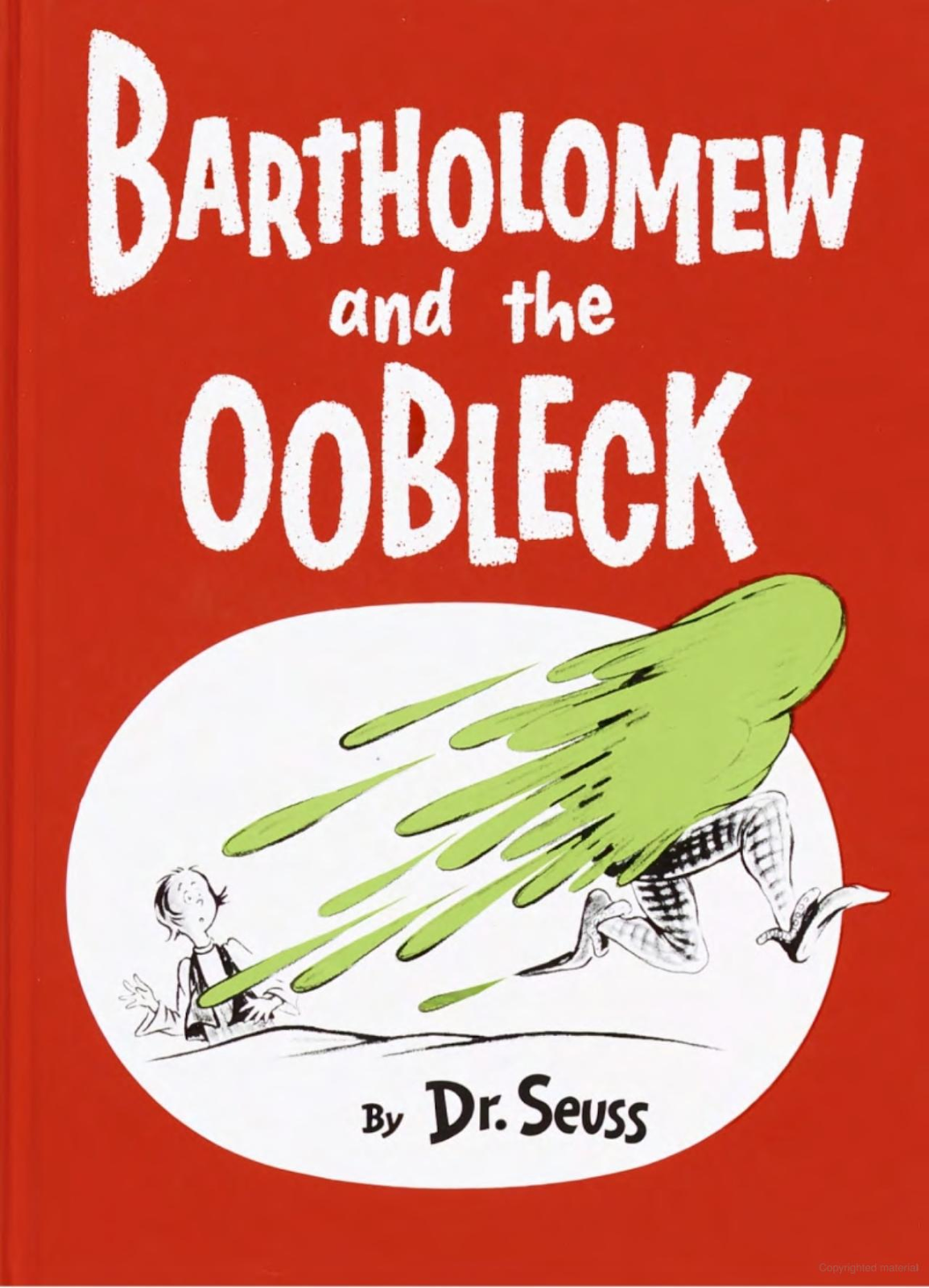
Homemade Dr. Seuss Oobleck, Gak Splat or Magic Melting Goop. These hands-on kitchen science recipe defy the laws of matter. Is it a liquid or a solid? In Dr. Seuss "Bartholomew and the Oobleck" a pesky substance with a mind over matter (properties of) leads poor Bartholomew Cubbins (of the many hats fame) and a wild Oobleck chase! Begin by reading this hilarious classic for March National Reading Month. Nickelodeon's Gak Splat of the 90s is a similar recipe. 

To make Oobleck, mix a little water colored green, in corn starch. Notice how it hardens to a solid then "melts" when you touch it. Put melting putty in the preschool sand and water table. Or fill a child's pool with cornstarch and water for hours of messy hands-on science experiments. Oobleck would make a great child's birthday party activity! 

Moldable Moon Sand. This dough recipe teaches ratios. The ratio is 2 to 1 to .5. Mix 2 cups of commercial play sand, 1 cup corn starch to one half cup of cold water (color water with food coloring if desired). Dissolve corn starch in cold water (cold doesn't clump, but you can let kids experiment with warm to discover that for themselves). Then blend sand and corn starch together. Make a large batch for classroom sand table. 

Perfect Playdough: Blend 1 cup salt, 2 cups of flour, 1 cup boiling water, 1 teaspoon of cream of tartar or alum, food coloring, cooking oil (about 2 T.) Playdough too sticky? Add flour. Playdough too dry? Add water or oil. Children love these kitchen science recipes. 

Homemade Soap Dough: Mix 1 cup powdered laundry detergent, an eighth of a cup of water and food coloring. Mold or sculpt as you would with play-dough. Store in refrigerator. 

Homemade Papier Mache. Tear any recycled scrap paper in pieces. Soak in hot water till pulpy. Add a dribble of white school glue. Blend till smooth. When cool, spread Papier Mache over boxes and containers to form shapes.  

Dryer Lint Dough. Teach ratios 1.5:1:.3. Mix 1.5 cups pressed dryer lint with one cup cold water and one third cup of flour. Add a drop of oil to prevent mold. Dissolve flour in cold water and blend to get rid of lumps. Carefully add lint and stir constantly until mixture forms stiff peaks. Mold like Papier Mache. 

Have children create homemade books of their activities by doing an LEA (language experience approach) story and letting kids illustrate their books. Homemade books are a perfect reading month activity. 

Recipes for homemade crayons using recycled broken crayons


With Earth Day, and Earth Month, fast upon us, I'm looking at ways to reduce, reuse, recycle and repurpose .Making crafts with recycled materials from the recycle bin is an excellent way to teach Earth Day eco-friendly habits. Here's are activities to use up those leftover broken crayons. Repurpose them as new crayons with these simple science activities. 

Have students gather broken crayons and peel off outer paper. You'll be making new palm held crayons similar to the egg crayons. These are popular in special needs or preschool classrooms use to help children who aren't quite ready for the stick crayons. Palm or egg crayons help toddlers, preschool and special needs kids develop fine motor skills while still enjoying coloring activities. 

Once you have pile of peeled crayon pieces, spray old recycled muffin tins with cooking spray. Use mini muffin tins for preschool and older children and large ones for toddlers as mini shaped crayons might look edible to toddlers. Have students place assorted bits of broken crayons in each tin. Aim for a rainbow of colors in each cup. Help kids place muffin tins in oven and heat to 200. Heat till crayons on melted but still chunky. Swirl with toothpick while warm if you wish. Place crayon melts in refrigerator till hardened then turn out of pan and enjoy coloring.

Be sure to only use recycled muffin tins for crafts, and not cooking, once you've done this activity. This is a great way to repurpose old muffin tins and give them new life. Use these free printable rainbow coloring pages to make beautiful spring crafts. Print coloring pages and printables on scrap paper from recycle bin for green, Earth Day ecofriendly activities. 

Healthy School Lunch Recipes: handhelds, pizza, tacos, burritos and breadless sandwiches


Juvenile obesity is a growing problem in the US and other nations. More kids experience excessive weight gain, not tween-age weight that will drop off after puberty, but life-long and are at risk of obesity-related health problems. There are some very simple strategies parents can use to help children with or at risk of obesity, without ever  mentioning weight loss. The two most important being diet and exercise. I'm not talking about diet as in specific calorie restricting. I mean monitoring what kids eat to ensure that they get maximum nutrition without extra junk calories. Here are healthy school lunch recipes for handhelds, "burritos" and breadless sandwiches to prevent childhood obesity. 

Handhelds such as sandwiches, burgers, burritos and hot dogs are the perfect school lunch food because they are less messy. And that's an important key right there. You can practice junk calorie restricting and  mess by just minimizing the condiments and using judicious condiment food swaps. Butter, mayo, jam and jelly, ketchup, mustard, dips and spreads are really not necessary in the amounts we use. Condiments alone contribute an inordinate amount to the calorie count while providing no real benefit. Some super nutritious condiment food swaps include:

cashew or almond butter (I'm a peanut butter girl, but sadly some schools have kyboshed peanut butter due to allergies. They shouldn't because it's just making allergies worse, but I digress)

hummus (look for lower fat, higher protein varieties or make your own)

salsa or pico de gallo (choose low sugar and low sodium and high veggie varieties. Eating salsa is a great potassium boost to prevent dehydration)

Some essential food swaps for sandwiches and burritos include low carb and keto breads and tortillas. So you probably know that white foods: bleached flour and sugar are the biggest problems with tortillas. Dr. Now of the anti-obesity reality TV show "My 600-lb Life" targets these on his "no white food" diet. But you can make a simple switch to low carb tortillas that provide a fiber and protein punch while still calorie restricting. Or go completely off book with breadless sandwiches wrapped in lettuce or kale leaves. 

Burritos, tacos and other handheld favorites can be reinvented in an endless number of ways for calorie restricting but also to boost nutrition. Spread almond butter on a low carb or keto tortilla and wrap around apple slices or a banana. Or spread with hummus, a little salsa and loads of fresh veggies. Or a cheese stick. Wrap tightly and slice, for pinwheels or "sushi." Speaking of sushi, why not make sushi rolls for super healthy school lunches?

Make pizza handhelds using thin crust pizza or low carb keto tortilla like Joseph's pita pockets or flax wraps or Light and Fit wraps. Spread with a little spaghetti sauce, sprinkle with low moisture mozzarella and turkey pepperoni. Make your own "make-your-own" Lunchables that kids can assemble at school. 

There are so many ways to keep kids fit and healthy without ever mentioning weight loss or diet. And add value by getting kids involved packing their own school lunches. Here are some free printable lesson plans on nutrition to help.